Showing posts with label shawls. Show all posts

Friday, May 16

More fun with mathematics (and knitting)

Just about anyone with a school-aged child is aware of the controversies in mathematics education. As a former math teacher and the parent of a ninth grader, I follow it pretty closely. The other day I read an article from a fellow arguing that algebra ought to be an elective in high school, that not many people ever have to use algebra in real life, so why make everyone suffer through it. He was especially critical of word problems and claims that there are no real life word problems that anyone would ever want or need to solve.

I guess he only knits rectangles.

I get lots of blog hits from folks looking for shawl calculation help. Many people knitting a triangular shawl from the top down want to know how many pattern repeats they can finish before they run out of yarn. I gave a method (using algebra) in this post and a follow-up in this post.

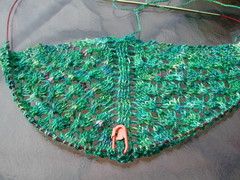
finished row 34

I recently started Ene's Scarf, my first triangular scarf/shawl knit from the bottom up. Meaning: cast on a terrific number of stitches, then decrease regularly until they are almost all gone, bind them off and block out to triangular shape.

Again, this isn't really a triangle, but a trapezoid. Cast on 375 stitches, decrease two stitches per row until you are left with 19 stitches, then do a bind-off that grafts them together.

This time, I know I have enough yarn. (Elsebeth Lavold's Silky Wool. Purchased to make Cozy from knitty.com, frogged for a variety of reasons.) All I really want to know is when I have reached the halfway point for the psychological assurance. However, if I were worried about having enough yarn, I would use the same calculations --- but factoring in the extra yarn used in the cast-on row more carefully.

First: Draw a picture and determine what I know and what I want to know.

trapezoid


For Ene's Scarf:

C = cast on = 375 stitches
B = end (not exactly bind-off, but close enough) = 19 stitches
H = number of rows = 179

note that if one really does decrease two stitches per row, the numbers are a teeny bit off -- one would end up with 17 stitches. That's because in this pattern, there are a few rows that don't follow the rules completely, but the difference is negligible for my needs.

Total number of stitches = Area of trapezoid = 1/2(C+B)*H = 35,263

I know that I will have knit half the scarf when I reach row h with r stitches where the area of the top trapezoid with base r is exactly half the area of the whole trapezoid.

I have two unknowns, h and r. Fortunately, I can solve for r in terms of h, so I will end up having an equation with one unknown and I can solve it.

h = rows left to finish
r = number of stitches in the row where there are h rows left.

So r = 19 + 2h

Area of top trapezoid is 1/2(19 + r) * h = 1/2(19 + 19 + 2h)h = 19h + h²


So we have to solve for h where

19h + h² = 1/2(35,263) = 17,631.5

h² + 19h - 17,631.5 = 0 is a quadratic equation, easily solved by the Pythagorean Theorem.

Do you want to see the calculations? I thought not. But I'll show you anyway. There are two real solutions to this equation, but we are only interested in the positive solution. Therefore, we only care about

(-19 + (19² - 4 * (-17,631.5))^.5) / 2 = 124 (more or less)

I will be halfway done when I have 124 rows left. 179 rows total, means I will be halfway done when I have finished 55 rows.

Friday, April 25

Blueberry Shawl

I've been having trouble deciding whether to knit a new sweater using stash yarn or purchasing more Cascade 220 to remake Forecast. And if I do reknit Forecast, what color? (I could always choose to finish a work in progress, but that's never as fun as starting something new!) So I went browsing at A New Yarn which has a decent selection of C220, but not the color of the Japan sweater. They do have a different yarn in the most gorgeous blue (Sapphire in this link, I believe). That would make a wonderful sweater, but it would cost more than twice as much as a C220 version. And infinitely more than knitting a sweater from stash.

So instead I wandered around and looked at the odds and ends. A New Yarn is a non-profit yarn store that raises money for a Women's shelter. They stock some good basic yarns but also take donations. So you never know what odd balls of Rowan or Malabrigo will be scattered around. I found a skein of Shetland in a tweedy blue-purple. It has a really old looking label and the colorway is Blueberry --- not one I can find currently for sale.

Blueberry
It is probably not a coincidence that I chose a blue-purple colorway. Not exactly the same as the Japan Sweater, but pretty close.

In one week it became a Flower Basket Shawl. I chose this pattern because I wanted something I knew would be easy to do without stitch markers since I have kinda lost mine all over the house. I knew the pattern would be easy to memorize and I knew it would be easy to add pattern repeats to maximize using the available yarn.

US 7 addi lace needles
9 pattern repeats
86 grams, 340-350 yards used
blocks to 63 inch wingspan 24 inches deep (could have been blocked deeper with less wingspan as well)

Wednesday, March 26

Sukoshi kanko-ga shitai-desu.

We interrupt blog silence to say so long, we are off to Japan. We have passports, rail passes, hotel reservations, two cameras --- but no laptop or cables, so photos when we return --- and the list of things to do includes at least one yarn store.

I did finish the Victorian Lace Today Large Rectangle and it is large. I didn't block it to its extreme, but to the extreme of my blocking board at 32x82 inches. I could probably have gotten a couple more inches in both dimensions. I love it anyway. And as for running out of yarn, I had 300 grams and used 286 grams. The calculator on ravelry says that is 1359 yards. I am too lazy to double check or to double check my calculations from when I worried about running out. The pattern calls for 1200 yards? I used the same weight of yarn as called for, I knit on similar needle sizes, but my finished dimensions are larger. So whatever, I had enough yarn.

Here's a photo of me trying to get all arty. I am imagining being lost out on the moors in winter with nothing but the pile of shawls I grabbed as I ran away. Would Jane's have been lace?

VLTmoors3

My latest knitting is a sweater that I really want to wear in Japan. However, it's not quite finished yet. Using Forecast, from Knitty 2005, I did some modifications which I am liking. Details on my ravelry page. Body is finished, button band done, buttons sewed on, ends are woven in, but the sleeves aren't going to knit themselves, so I better keep this post short. We leave in about 36 hours.

forecastbodydone

Saturday, October 27

Hairy Math

The Large Rectangle in leaf and trellis pattern with trellis border in Victorian Lace Today calls for 1200 yards of fine weight yarn.

Many people have found that they require more yarn than called for in VLT patterns.

I have three skeins of a fine weight Domy Heather, 100 grams, 475 yards each. A total of 1425 yards, 19% more than the requirements from the pattern.

Will I have enough?

You can skip the math and go right to the conclusions if you wish.

The main body is 94 stitches wide. 30 pattern repeats, 16 rows per repeat. Plus 5 set-up rows.

The border has an 18 row pattern repeat. There are 24 repeats on the long sides, 9 repeats on the short sides and 4 repeats at each corner.

The number of stitches in each row of the border varies, from 19 to 24, averaging 21.9 stitches per row. Not including the spit splicing, the ends woven in or the grafting of 20 stitches to finish the shawl:

Total number of stitches in shawl is 77,914

94 x 16 x 30 + 5 x 94 + 18 x 21.9(48 + 18 + 16) = 77,914

My first skein got me exactly 17 pattern repeats (plus 4 initial rows).

17 x 16 x 94 + 94 x 4 = 25,944

Therefore, I have enough yarn for 77,832 stitches.

25,944 x 3 = 77,832


I am 82 stitches short on yarn. But the border is done on smaller needles. I will optimistically knit on.

Friday, October 26

Getting Thing Done

cracked

Don't you just love getting things accomplished? Especially the small niggling things that have been on the To-Do list for ages. Like this stack of Tupperware with cracks that has sat on the pile of crap behind my computer monitor for at least a couple years. Lifetime warranty and all that, I could not find the address to return the items on their website. So I had to sit on hold for 30 minutes waiting for that nice polite young man with the thick Indian accent to provide it to me.

There's still a pile of crap behind my monitor (and next to it as well!) but every little bit helps.

In knitting, also some accomplishments. In the airplane heading east, I finished knitting two socks. All I needed to do afterwards was graft the toes. Anyone with experience carrying a tapestry needle on board? I didn't try. Neither did the two knitters I accosted en route. But you know, tapestry needles aren't sharp or anything. And they are pretty cheap, so losing it at security wouldn't have been the end of the world. Maybe I should acquire a plastic one, but I just don't fly very often. Regardless. They were both second socks, so after the grafting session in the hotel, I had two new pairs to wear. Alas, while Seattle weather has been in the wool sock territory for a month now, DC was still pretty warm.

curryfinished

BFL DK weight, hand-dyed by me. Top-down, garter rib leg and stockingette foot, US2 DPN, 48 stitches wide.

monkeyfinished

Knit Picks Fingering hand-dyed by me. Monkey Socks from knitting.com. Us2, pattern followed except I did a slip stitch heel flap.

More fun than socks that were too hot to wear, I finished a shawl in time to wear it to my niece's wedding. Zephyr wool silk lace, hand dyed by me. Luna Moth pattern (free on elann.com). US4 needles, who knows what gauge (I knit tightly in general). I did 7 full pattern repeats, plus the extra half a repeat to get the scallops on the end to point in the correct direction (following the pattern instructions). This blocked out to be almost 60 inches wide and 30 inches from top to bottom. It weighs exactly 50 grams, which means about 600 yards.

My blocking tools were limited, just my container of coil-less safety pins and a hotel carpet, so I didn't get the scallops as open and pretty as the ones on the elann site, but it still looked nice and I can always block it again.


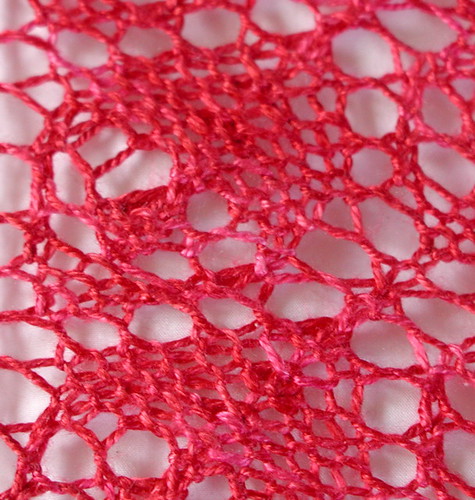
Luna Moth Shawl close-up

Thursday, August 9

Swans or peacocks?

Time for a question.

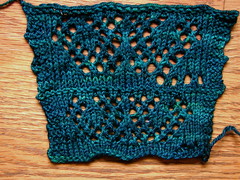
For Mystery Stole 3, I dyed some yarn. Melanie, the stole's designer, said that the theme would be best expressed in a black or white stole. (we now know that the theme is Swan Lake; a ballet I have not seen.) I chose to make a very dark green kettle-dyed yarn. This swatch is a pretty good representation of the result, which ended up more blue-green than green.


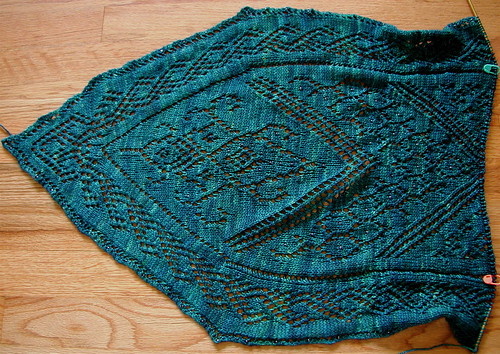
I kept up with the clues, knitting the stole, up through clue 3. Does it look swan like?


It's nice, but I am not feeling the love. Perhaps I am just not a stole person. Or maybe my idea of a stole is more like a wrap --- wider than 20 inches. My finished Leda's Dream is a generous 24 inches wide and I love how it wraps around me, but this one won't. The yarn, Henry's Attic Carrera, is lovely, but I just don't think it's the right weight for the stole. So I set it aside for a bit.

Meanwhile, after finishing Leda's Dream, I've been hankering to start something new --- Fiddlestick's Peacock Feathers Shawl. I dyed some yarn, Zephyr, thinking that I wanted something similar to the Carrera, a subtle variegated blue-green but also with an occasional blip of red and yellow, peacock-like. Well, I , um, forgot to add black so I got completely different results.


It's pretty, but not what I had in mind. So now I am stuck. What to do now? Should I keep going with the Mystery Stole and the Peacock Shawl or should I frog the Mystery Stole and use that yarn for a new peacock shawl?

Times like these sure make me wish I could knit faster. Then frogging wouldn't seem so harsh.

Friday, July 6

Mysteries

I have already finished Mystery Stole Three Clue Two!
just kidding! But it is downloaded, printed and 28% completed.

Since two of the big wheels in knit-blogdom, Bonne Marie and Stephanie, blogged about joining Mystery Stole 3 (signups close any minute now) the number of members doubled in a couple hours. I trust Melanie can take the excitement. Why would so many people be willing to invest their knitting time and money into a project where they don't know what it will look like? And me, I even dyed yarn specially for this.

The first two clues have each have about 5000 stitches. Not too overwhelming, especially in installments. I do expect to be finished with clue two today or tomorrow. Lace provides such a fun challenge. Melanie has added to that with a hidden theme. She won't reveal the theme for a while, but we do know that a stole closely following the theme would be either white or black but she warned us not plan to use this as a wedding shawl. Most likely the theme is a tragic love story. (Madame Butterfly? Swhan Lake? Othello? Knitters have been guessing.)

I do enjoy knitting for intellectual puzzles. New stitches, new stitch patterns, new yarns, new yarn combinations, new colors all stimulate the desire to knit. Erika offered a different sort of kntting challenge, when a while ago she discovered a handwritten cryptic pattern in her great aunt's knitting books. Numbers, letters in knitting shorthand and just a few words. Two important words --- sleeve & body --- told us that it's a sweater. The 'k' is clearly a knit stitch, but nothing else was evident. Page one seems to be missing, this starts on row 29. What's the size, the gauge, the cast-on? Can we reconstruct a pattern from it? To follow the discussion so far, go to Erika's blog, find the search box in the right hand column and search for Helen.

If you do, you can see many different interpretations were considered. I took a mathematical approach. How many k's, o's, sp's were in each row? How did the number of stitches change from row to row? In answering those questions, I finally narrowed it down. The only way I could make it work was to identify the o's as yarn overs and the sp's as a double decrease. That's the crux. Who, at first glance would think of a double decrease?

Basic pattern. multiple of 6 plus 3.

DD = double decrease. I slip two together knitwise, knit one, pass two stitches over.

Row 1: K3 *yo DD yo K3* repeat in asterisk til end of row.
Row 2: Purl
Row 3: K6 *yo DD yo K3* repeat til last three stitches, K3
Row 4: Purl

repeat for pattern.


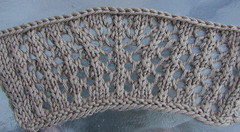
Helen's notes look a lot more complicated because she's making a sweater from the top down, with raglan increases following the stitch pattern. Can you see in the swatch below where I increased? Swatch is done with Brown Sheep Cotton Fleece on US7s. This would make a nice simple lacy summery sweater.


Tuesday, July 3

Lace

My list of finished knits includes a large proportion of lace.

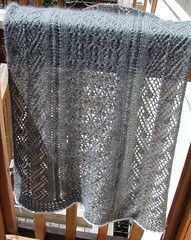
Branching Out in Noro Cash Iroha
Mountain Stream in Madil Kid Seta
Cece in Elizabeth Lavold Silky Wool
Spinner's Shawl in Corriedale - Romney from Oregon Trail Natural Fibers
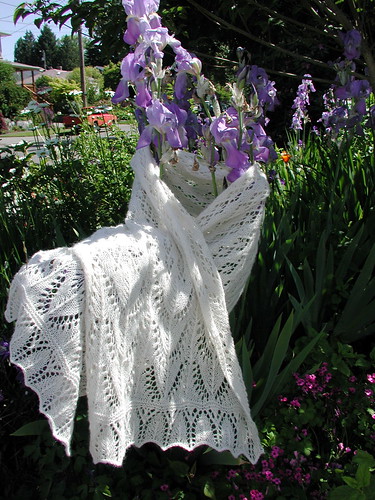
Flower Basket Shawl in Handmaiden Sea Silk
Estonian Garden in Frog Tree Alpaca

Lace satisfies an itch, an itch to try new technique, new fiber, new color, new pattern. And once you've bound off, just block and you are done! No sleeves to seam, no zippers to sew in. Well, Cece is a sweater, but is very simply constructed.

It's no surprise then that I have two lace shawls on the needles. Both are designed by Melanie.

Leda's Dream is almost half finished. I am knitting this on US6 addi lace needles (would have used 7's if addi would only make them) combining one strand of Zephyr and one strand of Madil Kid Seta. I love it, especially the Swan's Wing lace pattern, which I believe is from Barbara Walker. The central all-over pattern is also easy to learn and looks good. I could see a lightweight afghan knit with just that pattern and a garter strip border. She designed this as a mystery stole, offering the pattern for free in serial form two summers ago. Now she sells the pattern for a very affordable 2 dollars.

I joined Melanie's second mystery stole last summer, but never started. Turned out that the design never called to me. But I couldn't resist joining again this year. Why, when I have so many ideas of what to knit, would I join a group to knit a stole where I would not know the final design til late in the game? I don't know. Figured it couldn't hurt --- I wasn't required to cast-on. Well, we got the first clue and I have cast on, using some hand-dyed Henry's Attic Carerra and addi lace US5s. We still don't know the final shape of the stole, but it won't be a triangle. After 100 rows, there are 99 stitches on the needles, and Melanie says that's as many as we get. So, is this going to be knit on the bias or will it have pointy ends? Time will tell. The outer pattern is a variation of the Swan's wing pattern from Leda's Dream. I love the way she made that work, especially in the corner.

Thursday, June 14

Estonian Garden

My Estonian Garden Wrap (pattern by Evelyn Clark for Fibertrends) is done and I am most happy with it. The Alpaca blocked nicely to show the lace pattern and became very soft. It doesn't hold its blocking the way wool does, but for this stole, that hasn't been a problem.

Three and a half skeins of Frog Tree Alpaca Fingering weight, knit on Addi Lace US 5s.

There is one fault of this FO. Against all the warnings in every knitting resource, I used two different dye lots of the yarn. I had originally considered that I might dye the wrap after knitting, so I didn't care. But now I think I like the white and don't want to dye it. The color changes are almost unnoticeable. In fact, no one but me has noticed the different hues and I only noticed when I held it up in direct sunlight --- and the difference in colors was striking. Therefore, it is judged too flawed to give away, but not too flawed to keep. I just won't wear it on a bright sunny day!

Monday, May 7

Two Finished Knits (and one new)

Flower Basket Shawl, pattern by Evelyn Clark:
One skein of Sea Silk made on US 3 needles made a triangular shawl 60 inches across, 24 inches to the point. I used 94 grams of the skein and was able to make 12 pattern repeats. Previously I had calculated 12 repeats would use 86 grams of yarn. I still believe my formula was correct, but for some unknown reason, I had misweighed the yarn. I had thought that the tangled blob I had extracted from the 100 gram skein was 12 grams, but it was really only 7. How did I make that mistake? I don't know. The upshot was that I had thought the shawl weighed less than it really did. Fortunately I figured it out before starting pattern repeat number 13 which would have had to be ripped. I realized when uploading this photo that it was taken from the purl side. Oh well.

Micro Mini Clapotis. One half skein (about 60 grams) of AngoraValley sock yarn, knit on size 3 needles. I did only one or two increase sections (ended up with 45 stitches on needles) to make a skinny scarf. I am very happy with the size. Unstretched, after light blocking, it is 66 inches by 4 inches. I love it. Thanks, Erika, for the inspiration.


I have too many projects unfinished, mostly because they all need the sleeves finished. I think knitting sleeves is a royal pain because of those damned increases, so irregular, every 6 rows, every 12 rows, every what? So hard to remember to put them in correctly and you have to remember to do the other sleeve exactly the same. Maybe I am just cut out for knitting shawls and maybe vests?

To that end, I couldn't help myself, I started a new shawl. Also by Evelyn Clark, the Estonian Garden Wrap. The pattern calls for laceweight yarn and makes a wrap approximately 19 inches by 60 inches. I am using fingering weight alpaca. I wanted it wider, much wider would be fine with me so I didn't muck with the pattern. What I didn't know was how much yarn I would need. I had three skeins (50 grams, 215 yards), would I want more? How much? The pattern calls for a provisional cast-on, then knit the main body, knit the lily-of-the-valley edging, bind off, then go back and pick up the cast-on and knit the edging again. Instead, I did the provisional cast-on and knit the edging first. That way I could bind-off and measure, before picking up the cast-on for the main body. First edge weighed 40 grams and is about 14+ inches long (perhaps 25 to 30 inches wide?). I procured 2 more skeins which will make for a nice oversized wrap.

Wednesday, May 2

Victorian Shawls and Novels

Knitting:

I will have two FO's soon, the Sea Silk Shawl and a mini-clapotis. Sea Silk just needs the last row knit and then the bind-off. Clapotis is long enough to start the decrease section, so I have to either find the instructions that I printed off or reprint them again.

After that, my backlog of projects will only (!) be five sweaters and Dulaan hat number three to finish, and knit hats four and five to complete my promise.

I am not in love with Sea Silk. It is slippery and has no give so it is hard to knit, looks pretty, but not so pretty to justify the expense. And when it got tangled, it fused together in nasty lumps which makes me suspect it will pill terribly. I don't yet know how big the finished shawl will be, not till it's off the needles and blocking, but it won't be big enough to qualify as a real shawl in my imagining.

So, even though those sweaters are all sitting there trying to make me feel guilty, I am dreaming of knitting a real shawl. Something very big, at least 72 inches wide. Something soft, perhaps with mohair for extra softness. Something warm, but also something very feminine, soft flowery lacy pattern of some sort and a silk content for a sheen. Still contemplating patterns, and will work on the sweaters until a shawl pattern and yarn grabs me. To that end, I have ordered Victorian Lace Today. I think I'll find something appropriate there.

Reading:

Although she remained a lurker and didn't respond to my Jane Eyre question in the comments, Nancy the English Lit PhD gave me some insights into Jane from modern feminist theory. (Nancy has not read Jane Eyre in years and gave me a simplified explanation which I most likely am misinterpreting, though.) Bertha Mason symbolizes the repressed female sexuality in Victorian times, how she is in some ways Jane's alter ego. Too much libido got women locked up in loony bins. I can see that, but I also think that Jane is not all that repressed. She does want a sex life. But she is not willing to have a briefly fulfilling sex life that might ruin her long term happiness (Rochester's improper proposition) nor will she commit to a sex life that won't be fulfilling at all (Rivers' marriage proposal). And the message about too much libido is a warning to men as well as women; Rochester's giving into his horniness pretty much screwed his chances of lifelong happiness. He had to lose his eyesight and a limb in order to redeem himself and win Jane. Probably a fair trade. Rivers denied himself his horniness and ended up feeling fulfilled with his life. His words to that effect end the book. Is Charlotte's message really for men, in telling them they cannot "have it all"?

I've ordered Wuthering Heights; figured I'd see how Charlotte's sister's view of men and women and sexuality compares. Will Heathcliff be as flawed and creepy as Rochester? In the meanwhile, I went back to the other Jane, Ms Austen. Mansfield Park. It's pretty good so far. What was Jane Austen like in person, I wonder? In her writing, she is such a snarky lady, every paragraph holds a zinger.

Saturday, April 28

Trapezoid Shawl Formula!

An update on the shawl calculations. We aren't knitting triangles, we are knitting trapezoids! That explains the formula Susan and I each derived.

Recall from Algebra I: Area of trapezoid is 1/2(Base1 + Base2)*Height

In our cases, remember N = number of rows
Base1 = 7 stitches
Base2 = 2N+3 stitches
Height = N

voila! Number of Stitches = N² + 5N

Oh, why didn't I do this immediately instead of working out the sum from i = 0 to N of (7 + 2i)? Just goes to show that too much mathematics is a dangerous thing.

Kmkat, the Gaussian addition thing is from a (probably apocryphal) story of little smart ass future famous mathematician Gauss as a child and a teacher who was fed up and wanted some peace and quiet. She asked the class to sit quietly and add all the integers from 1 to 100. Gauss figured out almost immediately that the answer was 5,050. So much for the teacher's quiet afternoon.

As for me and my shawl last night I completed pattern repeat number 11. According to my calculations, I have knit 74.4% of the shawl and according to my scale I have used 73.8% of the yarn! It will be close. That's using the 12 repeats/88 grams. Have to admit I am tempted to work some more on untangling the 12 grams and adding an extra repeat. If all goes well, if I can manage to untangle the whole thing, I can complete 13 pattern repeats and end up with about 2 or 3 grams left over.

Friday, April 27

Triangle Shawls and fun with algebra


My first Triangle Shawl was Evelyn Clark's Spinner's Shawl pattern, modified to be stockinette rather than garter stitch. It's a bit small, but I did a pretty good job of using most of the yarn I had. I love it and wear it around the house a lot as a little extra layer around the neck. I even got so bold as to wear it in public; even though I am lacking an accessories gene --- wearing anything extra unnecessary to maintaining modesty and a normal temperature usually makes me feel exposed and awkward.

Triangle number two is being knit with Sea Silk. I only have the one hank, I want to use as much of it as possible. This requires a few things easy to find household items; a scale, a calculator and some mathematics.

Pattern is Evelyn Clark's Flower Basket Shawl found in IK. I won't bother to dig out the exact issue, because everyone has already knit this pattern. I chose it because the pattern repeat is only 10 rows and the edging is only 12 rows (10 pattern rows and a bind-off). It will be easier to squeeze in as many pattern repeats as possible instead of a shawl such as the Spinner's Shawl where one must stop with the pattern repeats in time to commit to 40 rows of edging. Admittedly it makes for a more interesting shawl to have a different and complimentary border, but so it goes when the Sea Silk is so dear. Flower Basket it is.

Jessica has a shawl calculator on her blog but alas, it is in excel, something my poor little mac cannot read. So I got some paper and a pencil and worked it out myself. Eventually I did read her spreadsheet on my husband's computer. It is fine, but hides the math. So I am glad to have done this work anyway.

Much calculation, much scratching out, much musing, some greek letters and that Gaussian addition trick and I found a formula to compute how many stitches have been knit given the number of rows knit. Before writing it up, I searched the net a bit more and found that Susan had posted an alternate calculation, much simpler. She didn't simplify into algebra, so I did and it resulted in the same formula I found. Although I'm a little chagrined that I took a more circuitous route, in the end having my formula be the same as hers gives me confidence.

Here it is:
While knitting a triangular shawl where one starts with 7 stitches (ignore the set-up rows which use a trivial amount of yarn in the grand scheme of things) and increases four stitches every right side row, if N is the number of rows that have been knit then the total number of stitches done is N² + 5N. (now that I think about it, I am guessing one could derive this from a simple area of triangle formula.)

How does one use this delightfully compact formula? Well, I have knit 10 pattern repeats so far. With 26 rows to prepare for the main pattern, 10 rows per repeat, I have knit 126 rows. Therefore I have knit 126*126 + 5*126 = 16,506 stitches in total.

My scale says this weighs 55 grams, or about 300 stitches per gram.

Looks like plenty of yarn for another pattern repeat or two. Keeping in mind that the finishing will require 12 rows, how much yarn can I expect to use if I knit a few more repeats?

11 repeats: N = 126 (rows so far) + 10 (11th repeat) + 12 (border/finishing) = 148

148² + 5*148 is 22,644 stitches. At 300 stitches per gram, this will use 76 grams of yarn.

12 repeats: N = 158 Total Stitches = 25,754 or 86 grams

13 repeats: N = 168 Total Stitches = 29,064 or 97 grams of yarn.

Now, to tell the truth, I have 88 grams of yarn. Yes, I started with 100 grams, but we won't talk about how the Flower Basket pattern was not my first attempt, nor what happened to that tangled mess of crap 12 missing grams. So I can knit two more pattern repeats, 12 total, then work the edging. I ought to come very close to using up the 88 grams available, and if I go over by a few yards, well, I might be able to resurrect a few yards from the trashed bit.

Isn't it grand? I just love quadratic expressions, this one is so tidy and clean! And the thought of knitting just two more repeats and the edging sounds infinitely doable, after all, I've already done 10 repeats, what's a few more?

Of course, anyone who has actually knit a triangle like this is smirking at that statement. Looking at it from a more realistic perspective, I have knit 16,506 stitches and I will be knitting a total of 25,754 stitches. Therefore, I am only 64% done.

Sunday, February 11

Milestones

sun power


A year ago yesterday the solar panels were installed. As of noon today we've produced 2432 Kilowatthours, about half our annual electricity usage.


Our last backyard egg of 2006 was from Lucy on the Winter Solstice. This morning I noticed that Orpington's crest was looking a little more perky and red. Could this be a sign that she was getting ready to lay again? Yes. Let's hope the other girls follow the leader.

Sitemeter told me someone found my blog googling on Orpington lavender eggs. Our Buff Orpington lays brown eggs.


I just finished my first triangular shawl. A shawlette; I knit fewer repeats than called for and it's blocking to about 48 inches across, 25 inches deep. The Spinner's Shawl by Evelyn Clark, in hand-spun, kettle dyed Corriedale I purchased at Madrona from one of the small local vendors. The pattern is a garter stitch shawl. As you can see, I made it stockinette. Will explain more once I get a post-blocking shot.

Someone else found my blog searching for house of flying daggers shawl pattern. What an interesting idea for a shawl. I can just see it now, an interlocking dagger motif with a feather edging. As far as I can tell (by googling on the same phrase with quotes around it) no such pattern exists. yet.